DAREN TRINH
Unity Developer | Gameplay Programming | Technical QA
Development History
Our team spent a lot of time iterating on different control schemes to which we landed on streamlined simplistic controls to fly the ship. We started with an advanced flight system in which the player controls the speed and rotation of all axes and ended on a system in which the player controls the speed and only two rotation axes.
This project originally started as a racing Taxi game similar to Crazy Taxi, but the team chose to switch focus from a fast-paced chaotic taxi racing game to a visual novel game with slower paced taxi driving mechanics instead. This change resulted in the change in flying mechanics and the core level design as we shifted from planetary travel to an enclose city design to match the movement pacing and mechanical skill gap for movement.
This project was my first attempt at 3D modeling assets and integrating them into the Unity Project. The models were developed in Autodesk Maya.
Notable Features
Dialogue System
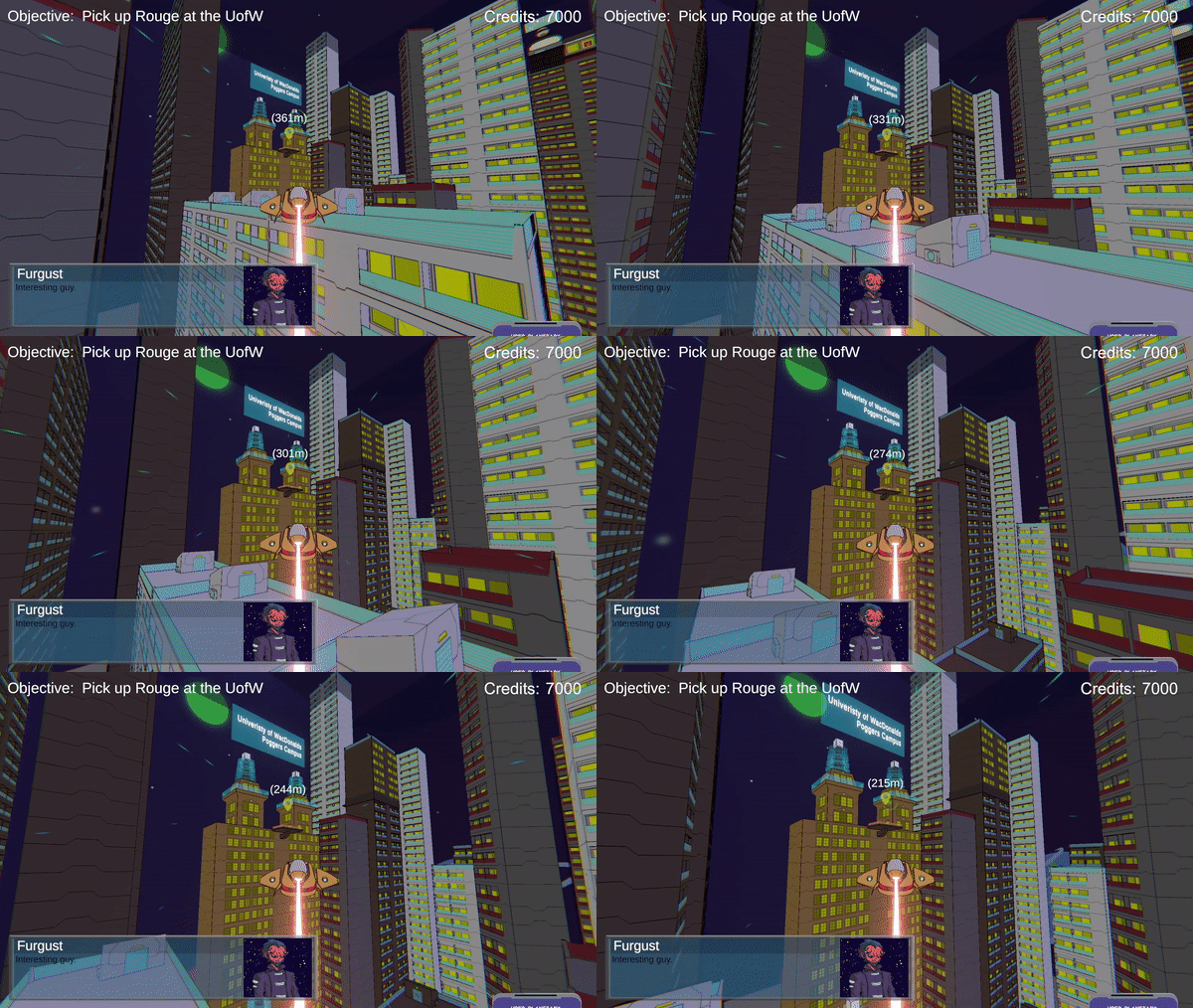
On this project I've worked on finishing the dialogue system for the game and integrating the narrative dialogue into the gameplay. We utilized scriptable objects to create "quests" that would carry lines which our dialogue manager would read from. These dialogue lines would be easily populated with however many lines a customer could have.
We also had customer scriptable objects that carried these dialogueSO's which allows us to be able to easily create new passengers on the go, streamlining work for our writers and artists as they can populate new customers with their dialogue lines and attach a face to each new passenger we pick up.
The challenge became trying to create customer "quests" that would be narratively engaging while fitting within the duration length of travelling from one objective point to another. Due to the size constraints of the map, the bottle neck of the amount of art assets that could be created, and development time, most quests that were made only lasted around a 1-2 minute travel time, which meant the narrative of each trip needed to be short, or a multi-step ride which was implemented mostly for main narrative quests.
Testing & Validation
During development, I examined the dialogue system and its integration with the game's quest and customer structures to ensure that narrative content was retrieved and displayed correctly.
This involved reviewing how customer ScriptableObjects referenced their associated dialogue data, checking that the DialogueManager accessed the appropriate dialogue entries, and considering how dialogue progression was affected by different quest scenarios. I also evaluated the relationship between travel duration and dialogue length to ensure that conversations aligned with the pacing of gameplay.
This process provided experience working with interconnected gameplay systems, reusable data structures, and validating how changes to one component could affect others.

